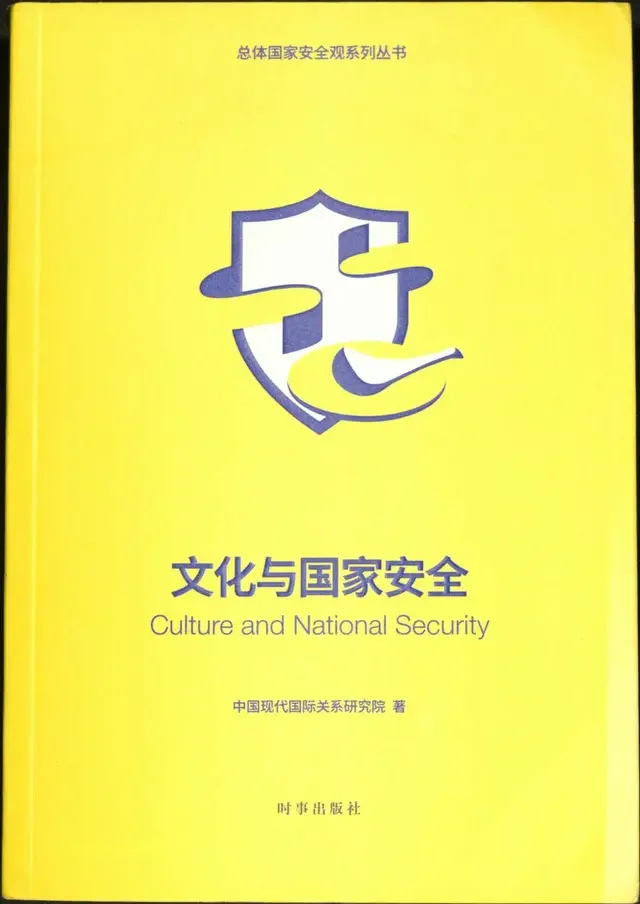
Front cover of Culture and National Security published in 2021
What does it mean for New Delhi if China understands Indian ambitions for great power status as fundamentally undermined by central aspects of India’s traditional culture? Might this confirm a basic Indian suspicion that China is unwilling to respect India’s growing material power and status? These are real questions prompted by reading a leading Chinese think-tank’s work arguing that the Hindu caste system will prevent India’s emergence as a truly global power.
Given widespread uncertainty over Beijing’s strategic intentions, it is always useful to dissect Chinese perceptions of other countries. I was pleased recently to come across a 2021 book by the China Institutes of Contemporary International Relations (CICIR) titled Culture and National Security, which contains this chapter: ‘The Caste System and Turmoil in Indian History’. CICIR is a think-tank close to China’s Ministry of State Security. Its Wikipedia page states that it is a ‘front to influence foreign diplomats and academics and collect intelligence.’ While I ask myself what think-tank is not trying to exert influence, if it is close to China’s intelligence and security authorities then its publications are of great interest. The book has been translated and made available to read online through the ‘China Open Source Observatory’, a fantastic project managed by Rush Doshi and Tanner Greer at the Council on Foreign Relations in the United States. It should be noted that they make clear that the translation was done by Anthropic’s Claude Sonnet 5, unlike other materials which have named translators. However, the translation sits alongside the Chinese original, so can be easily checked (and should be because there are errors).
Culture and National Security unpacks what it calls the ‘cultural code’ of national security and pushes back against the American concept of the ‘clash of civilizations’ and the way in which that is linked to the ‘ideological encirclement campaign against China’. The authors are clear that China sees things differently: civilisations ought to be in essential harmony rather than in conflict. Underlining this difference, the authors describe how Western imperialism has wiped out and disregarded other civilisations and argue that confrontation has been central to Western civilisation. The introductory chapter then explains that the book will explore the civilisational essentials of various countries including India, Japan and Israel and how these factors frame their international postures.
The India chapter itself voices scepticism that India has much history to speak of and quotes Marx to make the point: “What we call its history, is but the history of the successive intruders who founded their empires on the passive basis of that unresisting and unchanging society.” The claim is especially provocative because it echoes the prejudices of India’s British rulers. Remember Macaulay’s infamous ‘Minute on Indian Education’, which stated that ‘a single shelf of a good European library was worth the whole native literature of India and Arabia’.
The Chinese authors also repeat the disparagement of Indian unity which was one justification for colonial rule. ‘India’, they say, has been less a political category and more simply a geographic term used to denote the ‘Indian subcontinent’. While the rich culture and resources of the region are recognised, it is argued that Indian history is mostly defined by ‘a state of fragmentation, disunity, and conflict’. Moreover, a contrast is drawn with China’s far more cohesive history. While periods of unity and disunity can be roughly said to be in a ratio of 7:3 across all of Chinese history, for India the ratio is reversed, at 3:7. Indian history is sketched out with the great unifying dynasties shown to be rather short-lived and/or not of actual indigenous origin. The Mauryas and Guptas were both particularly brief and in their Buddhism - or tolerance of Buddhism - not definitively Indian and Hindu. Other periods of sustained unity were under distinctly alien rule: the Mughals and the British. And the period of independence that began in 1947 was also marked by renewed subcontinental disunity with Partition (though this point is implied rather than explicitly made). Nonetheless, the book’s prejudice against the idea of Indian unity is clear.
The authors blame the caste system for the inability of local forces to sustain Indian unity. The failure, they say, stems from the ‘deep wellsprings of India’s profound traditional cultural genes’. Several reasons are given for caste’s fissiparous effect. First of all, caste locks Indians into fixed occupational roles which are by definition unequal. Again, a contrast is drawn with China, which for centuries had an essentially meritocratic principle at its core epitomised by the civil service exam system. Another caste-related factor which impeded the idea of ‘grand unification’ was the dominance of the village. The unusually autonomous and self-sufficient nature of India’s villages was closely related to the way in which the village was structured around fixed caste-occupations. This meant there was little idea of political or economic ties and loyalties beyond the village, diluting notions of a wider state or nation. Furthermore, life within the caste system was driven by the belief that fulfilment of one’s caste duties would be rewarded by rebirth in a higher caste. So the overriding imperative is individual acceptance of one’s place in the material world. The authors claim that this ‘traditional culture meant that national heroes who resisted foreign invasion carried little aura of glory; their image was no more exalted than that of an ascetic monk within caste society.’
The authors provide historical examples of how they say caste has undermined a unified Indian nationalism. For instance, when the invading raider Mahmud of Ghazni sacked the great Hindu temple at Somnath in 1025, the lack of resistance offered by the surrounding villages is explained as being due to their insufficient loyalty to the temple. Furthermore, Indian recruits to the British Indian Army saw their service as loyalty to their own caste function (as members of a lineage of warriors) rather than betrayal of the Indian nation. This expression of caste loyalty remains powerful today. The authors use as an example events in 2018 when the Mahars (a Dalit community) commemorated their 1818 participation in the British conquest of the Peshwa regime of the Maratha Empire. These large-scale celebrations provoked major attacks and accusations of treason. The authors claim that modern caste politics is a major cause of political disunity and undermines India’s rise as a great power. Towards its end, the chapter asserts:
As various parties go to great lengths to secure the support of voters from their own caste, the politicization of caste has not only further entrenched the divisions, oppositions, and living space between castes, but has also brought about a severe fragmentation of India’s political landscape, hindering the pace of India’s rise as a great power.
In fact, the authors aver, India is no closer to ‘becoming a great power’ than in Nehru’s day.
What then can we take from this Chinese perception that India’s rise as a global power is profoundly inhibited by the persistence of caste?
I am no expert on the long arc of Indian history. Others are far better placed to judge the accuracy of this Chinese account, though it certainly contains inaccuracies and generalisations. But, as someone who thinks about contemporary China-India relations, I am interested in Chinese perceptions of India today. This chapter reminded me how earlier generations of Chinese intellectuals like Kang Youwei and Lu Xun saw India’s submission to British colonialism as a cautionary tale in which its lack of unity undermined its ability to resist external power. It is striking to see a similar understanding survive today. Maybe it is rash to read too much into one chapter in one book, but CICIR is an important think-tank that is close to the PRC’s security and foreign policy establishment. An overall assessment of India as possessing a fundamental tendency towards disunity might be one reason why Beijing often seems unwilling to regard Delhi as a genuine or even potential peer in Asia.
The disconnect between how China perceives India and how Indians perceive their own country is significant. In particular, by highlighting the deleterious impact of caste, this chapter implies that Hinduism itself is a source of Indian weakness. This is in stark contrast to the basic outlook of Prime Minister Modi, the governing BJP and their many supporters who see Hinduism as a source of India’s growing power.
A major problem in China-India relations today, at least from the point of view of many Indians, is an apparent unwillingness of Beijing to recognise India as a great power. Asymmetry is a real problem in the relationship. No doubt China’s far larger economic size partly explains Beijing’s dismissive attitude towards Indian sensitivities about China’s growing presence in South Asia and the Indian Ocean. But the attitude revealed in this chapter suggests a deeper scepticism of India’s ability to emerge as a truly unified global power. And, if this is true, then China is less likely to grant the concessions to India which might be necessary for the two Asian giants to find a genuinely stable relationship for the long term.