Losing the algorithm: what one small company's fear reveals about China's appetite for foreign technology
A few years ago I did some consulting work for a small European medtech start-up on the question of entering the Chinese market. China looked like an obvious destination for its algorithm-based diagnostic tool: a huge patient population, a real shortage of specialist screening capacity, and a government that talked constantly about wanting more technology in its healthcare system. However, in the end the company did not go in, and the reasons why have stayed with me; picking these apart now feels more useful than it did at the time — not least in terms of Sino-Indian relations and Delhi's hopes of securing more of China's healthcare market.
What worried my client was neither regulation nor price. It was fear of losing control of the algorithm itself, whether through a joint-venture partner, a regulator requiring disclosure, or simple copying once the product was visible in the market. One law firm we consulted was blunt: assume you will eventually lose the IP, so decide whether the revenue available in the meantime is worth it.
There were real pathways into the Chinese market. We secured a number of offers of genuine partnership, including the possibility of piggybacking on an existing large-scale clinical study. More formally, China has built schemes like its Greater Bay Area Initiative specifically to let foreign health products into a small number of pilot hospitals ahead of nationwide approval. However, the client decided not to explore these possibilities, partly due to limited resources but also a distinct unease about what would happen to its core technology.
One practical response to this kind of fear, at least for companies with sufficient patience, has been to keep the patented core technology and manufacturing at home, and license a domestic partner only for what must happen locally, such as registration and clinical trials. It has been a sensible enough way of managing exactly the risk the start-up was worried about.
Here I think the original research was prescient. It had highlighted data regulation as a new key concern and recognised that this was actually part of the IP risk. Any diagnostic tool that needs to be proved to work on a local patient population needs validating on local patient data. China's new data laws, tightened through 2021, require such data, and often its processing, to stay inside China, usually under a domestic partner's control. Rules on cross-border transfer of data hardened further the following year. My own notes from the time made the connection directly: satisfying these data rules was not simply box-ticking, it created an IP risk in a different form, since a domestic partner responsible for processing that data needs enough working access to the algorithm to run it. China presents these rules, reasonably enough, as protecting national security and patient privacy, but they are certainly appreciated also for keeping the most valuable part of a foreign product inside Chinese hands. Either way, if you cannot control the data your algorithm needs, you do not really control the algorithm, no matter how careful your lawyers have been.
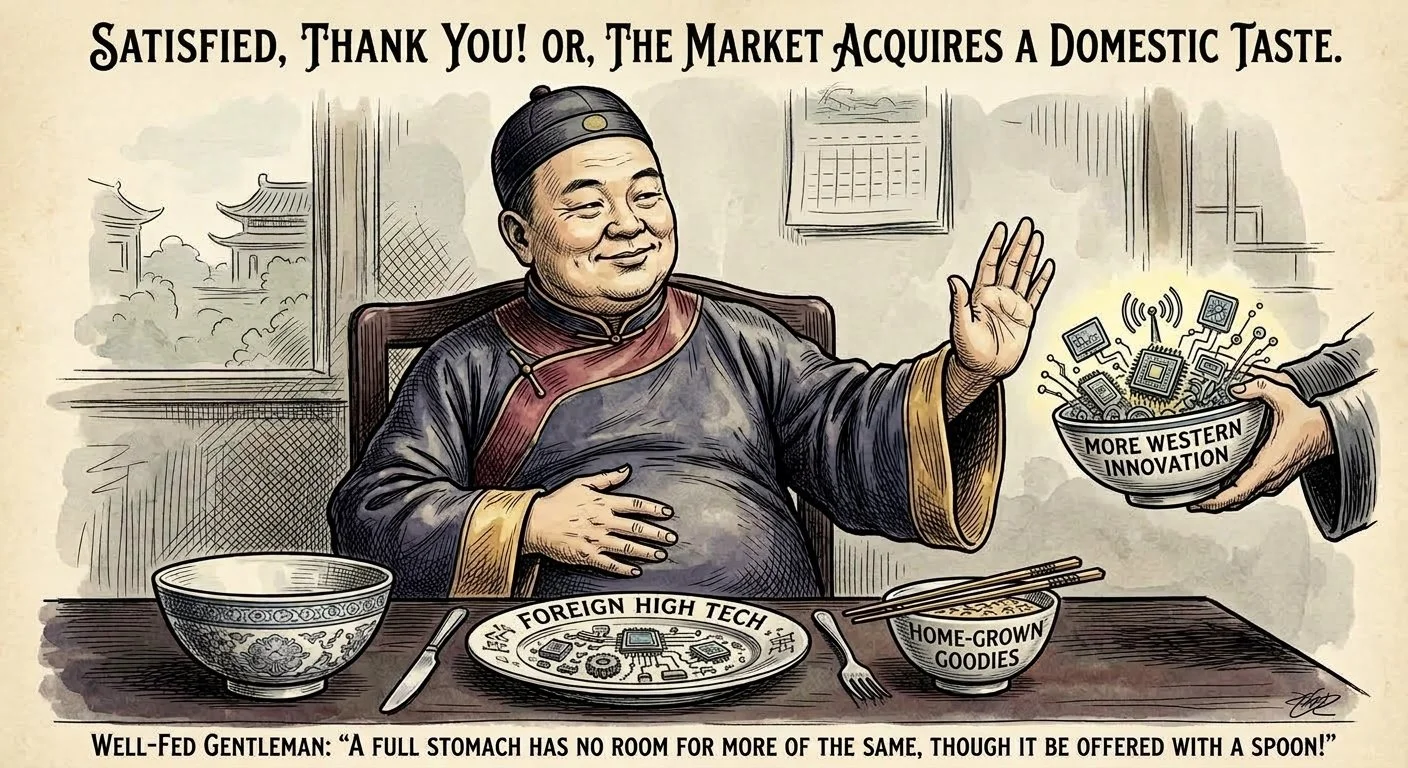
The broader context has continued to move in the same direction. China's Fifteenth Five-Year Plan (2026-30) puts self-sufficiency in advanced technology at the very centre of economic strategy. Many argue that Beijing sees its lower growth target, of 4.5 to 5 per cent, as a worthwhile price for that wider goal. The plan frames the objective explicitly as self-reliance, meaning a reduced dependence on foreign technology rather than simply the accumulation of domestic strength alongside it. China's drive for self-sufficiency spans several fields — semiconductors, biotechnology, quantum computing among them — but AI resonates most directly with a diagnostic tool built on an algorithm. The underlying instinct to pursue high-tech self-reliance was already at work in the early 2020s but the Fifteenth Five-Year Plan has made this overt national strategy. A China whose stated aim now is to need foreign technology less has little institutional reason to protect foreign IP or to nurture the companies that hold it.
None of this, of course, is a new observation. That a country's willingness to make room for foreign business mirrors how much it still needs from that business, more than any commitment to ideas of free and open markets, is not a new insight into China's economic relations. But the start-up's experience suggests something more. The data rules we ran into back in 2021 and 2022 were not simply a technical obstacle sitting alongside the IP risk; they were an early, small-scale sign of the same logic that self-sufficiency policy now applies openly and at national scale. What felt at the time like an obscure worry about where patient data could be stored turns out, in hindsight, to have been a harbinger of where the whole system was heading.
I think about China and India most days, in one professional capacity or another, and India, naturally, is of a different character and scale from this one small European start-up. India has major pharmaceutical manufacturing capacity, and has been seeking better access from China for years. India's interest is more generic drugs than high-tech medical products, which makes the comparison with the start-up's experience an imperfect one. And China is also a vast producer of generics, so India's problem is more ordinary price competition and procurement bias than IP risk per se. But if the start-up's experience exposed an early sign of where China's system was heading, India's frustration may result from a fuller, more advanced manifestation of China’s general desire to minimise dependencies on foreign tech and key inputs. Many now ask how much room China is prepared to make for outsiders in fields where it is working hard to need them less. Voices in India emphasise closer economic ties as one important lever for improving the wider relationship with China, but the sort of structural barriers to improved trade discussed here may well outweigh the past year's warmer mood evinced by the border thaw and Xi Jinping's recent presence in Delhi for the BRICS summit.