Strategic Sympathy for China? Lessons from the Sino-Indian Border
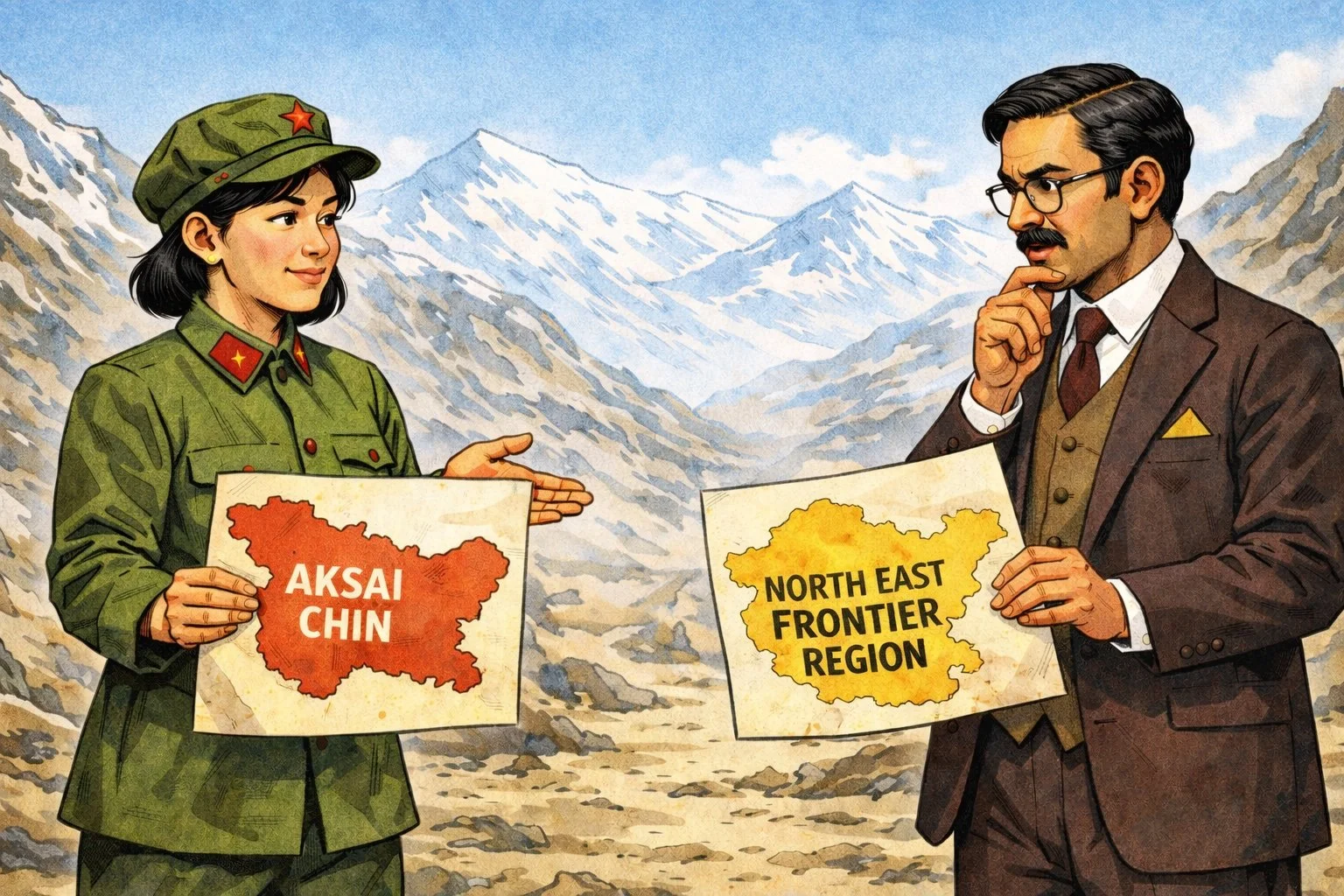
Revolutionary China pragmatically offered legally-minded India a straightforward swap of territory in 1960
Public and policy discussions about China in India (and in the West also) often begin from the assumption that the People’s Republic is, by nature, aggressive, expansionist and increasingly belligerent. China is cast as revisionist, intent on overturning the status quo. But such language obscures much. When we look closely - both historically and today - China often appears more pragmatic and reactive than the caricature allows.
This is not an argument that Beijing is benign or always reasonable. Rather, it is a plea for analytical precision. Before labelling every Chinese move ‘aggressive’, we should ask what Beijing perceives and the constraints and pressures it faces in any given situation. The Sino-Indian border dispute in the 1950s, and more recently, offers a useful case study, partly because it has shaped the security environment of the Himalayas ever since. But it also suggests that a more sympathetic reading of Chinese behaviour may help defuse some of the inflammatory narratives dominating international affairs today.
India and China both emerged from the 1940s as post-colonial states with ill-defined borders. However, despite its post-colonial identity, the independent Indian state maintained substantial continuity with the British Raj in terms of law, institutions, and frontier practices. The borders it claimed, such as the McMahon Line (drawn by the British in 1914 and still today marking the unstable separation of India’s Arunachal Pradesh from China’s province of Tibet) were products of this imperial legacy. New Delhi justified its claim to territory south of that line, and elsewhere, as its legitimate inheritance of the legal rights of the British Indian state.
China’s approach was different. In line with the ambitions of the preceding Republic of China, the communist leadership of the People’s Republic of China sought to restore the physical outlines of the old Qing Empire (1644-1911). But the integration of Tibet into the new state would be done on revolutionary grounds, not legal. Beijing framed its moves in Tibet as liberation from feudalism, anti-imperialism, and the expulsion of hostile foreign influence. It explicitly rejected the laws that had been one of the key means by which old China had been subjugated by imperialism: the infamous ‘unequal treaties’.
Crucially, both sides operated amid profound ignorance. Beijing had a limited understanding of Tibetan history and culture in general, let alone Himalayan geography. Zhou Enlai, the PRC Premier, admitted privately to Indian interlocutors that they had been unaware of the McMahon Line. Delhi, for its part, had never physically administered or surveyed many of the remote tracts it now claimed. In 1951, the Indian Army was ordered to rush up and occupy Tawang, making real a somewhat theoretical claim on territory south of the McMahon Line. In the later 1950s, when the border dispute became live, India sent researchers to archives in London to ascertain exactly what Delhi could justifiably claim. Prior to this neither government possessed authoritative knowledge.
This mutual uncertainty produced what might be called the policy of silence. Nehru refused to raise the border question formally, insisting that India simply treat it as settled and publish maps as if nothing were contested. Beijing, unsure of its own claims, avoided discussion as well. The 1954 Sino-Indian agreement on Tibet - covering trade, pilgrimage, and diplomatic facilities - carefully excluded the border altogether. Both sides interpreted the silence differently: India believed China had tacitly accepted the status quo while China thought the agreement covered only issues ‘ripe for settlement’.
This silence masked massive differences. The shock in New Delhi when India discovered in 1958 that China had built a road through Aksai Chin - territory India claimed as part of Ladakh but did not control - was therefore immense. Border skirmishes in 1959 at Longju (in the easter sector, along the the McMahon Line) and especially at Kongka La (the western sector, in Ladakh) made clear that Indian and Chinese understandings of the frontier were in conflict.
One of the most revealing episodes came in 1960, at a moment of profound crisis for China (the Sino-Soviet split was taking place while China suffered cataclysmic famine). Border talks between Chinese and Indian leaders were held in April in New Delhi. At these, Beijing requested that legalistic arguments be dispensed with and instead suggested a political bargain: China would accept Indian control in the eastern sector (then called the North East Frontier Area and now called Arunachal Pradesh) if India accepted Chinese control over Aksai Chin.
For Beijing, this was the pragmatic core of the issue. The road through Aksai Chin - built without Indian knowledge in the 1950s to connect Xinjiang and Tibet - was essential. The eastern sector was symbolically important but strategically less vital. China’s conduct of the war in 1962 can be interpreted as a reprise of this pragmatic ‘swap deal’: the PLA held onto the territory it took in the west, demonstrating the importance of Aksai Chin, but dramatically withdrew back north of the McMahon Line, indicating its flexibility in the eastern sector.
None of this means Beijing was innocent or blameless. But its thinking was rooted in a kind of strategic pragmatism often overlooked in popular narratives.
Nowadays, it is common in both India and the West to merge the Himalayan border dispute into a wider story of Chinese assertiveness: the South China and East China Seas, pressure on Taiwan, wolf-warrior diplomacy (Chellaney.net). In this account, the Xi Jinping era is portrayed as a sharp turn towards expansionism.
Yet this narrative sidelines Indian actions that Beijing plausibly regarded as threatening. From the mid-2000s, India looked to accelerate its border infrastructure programme of roads and airstrips to bring Indian capabilities closer to the Line of Actual Control on the disputed border. It also took steps to reorganise its military structures to emphasise deterrence of the China threat (Jamestown.org; TribuneIndia.com; NIDS.mod.go.jp; Orfonline.org) Although implementation of the infrastructure plans often suffered various delays it contributed to a classic security dilemma. So while India sees all this as legitimate modernisation of its defence capabilities, in Beijing it looked like an unsettling change to the status quo.
Similarly, the transformation of US-India relations between 2000 and 2008 - culminating in the civil nuclear deal - was watched in Beijing with deep unease. Beijing was concerned that the agreement between Washington and New Delhi would undermine the global system of non-proliferation. But even more than that, China interpreted these developments as the integration of India into a nascent anti-China security architecture (OutlookIndia.com; Jamestown.org).
Furthermore, while episodes such as the 2017 Doklam standoff (near where the borders of China, India and Bhutan all meet) are seen in India as a Chinese effort to change the balance of power in that area of the border (BBC.com), it also reinforced decades-old negative Chinese perceptions of India. Beijing understood these events partly as India once-again behaving as a regional hegemon, interfering in relations between China and other South Asian actors. Since the 1950s, the Chinese have accused New Delhi of seeking to control its smaller northern neighbours like Bhutan and Nepal, preventing them having regular relations with other powers, and China particularly.
Stepping beyond India, it is not hard to see why Beijing believes the United States has sought to contain it for decades. As examples, Chinese analysts routinely cite the 1999 Belgrade embassy bombing, extensive US surveillance and patrols along China’s coast, arms sales to Taiwan, US alliances with Japan, Korea, Australia, and others. Furthermore, an underlying hostile assumption of much of America’s China policy for decades has been that China’s political system must change. All of this means that Chinese fears of US encirclement are not imaginary and ignoring those concerns risks misreading nearly every major flashpoint in the region.
A more sympathetic reading of China does not mean endorsing Beijing’s positions or minimising genuine concerns about its policies. Rather, it encourages reflection on Chinese action as the product of threat perceptions, historical experience, and carefully weighed pragmatism, not simple expansionism.
In the Himalayan context, what mattered to China in the 1950s remains true today: sovereignty over Tibet, control of vital infrastructure, and avoidance of hostile alignments on its periphery. In the wider Indo-Pacific, the red line is Taiwan, but the status quo there remains tolerable so long as Beijing believes it is not being eroded.
Recognising Chinese motives will not resolve disputes. But it may lessen the appeal of more alarmist narratives, cool public discourse, and make possible more constructive engagement. Such sympathy is not naive, it means understanding how your adversary reads the world. In an age of growing paranoia, that is an analytical skill we badly need.